
Multicultural Disaster Prevention Page
At SenTIA, we are continuing work on “Multicultural
Disaster Prevention” (multiculturalism through local disaster prevention
activities).
Our goal is to create local communities where everyone can live safely and
securely regardless of their culture or language.
Disaster Multilingual Support Center
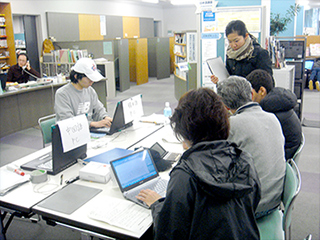
When a large-scale disaster such as an earthquake occurs, SenTIA will begin operation of the Disaster Multilingual Support Center, set up by the City of Sendai, working together with volunteers and related organizations to provide necessary information to disaster-affected non-Japanese people in foreign languages.
For more information about the Disaster Multilingual Support Center, please click here.
Disaster Multilingual Support Volunteers
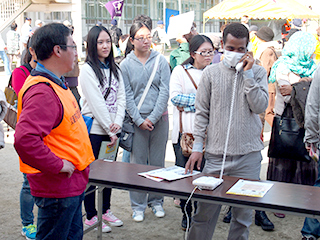
When flooding, earthquakes, typhoons or other
large-scale natural disasters occur, there are volunteers who offer support to foreign
residents in foreign languages. These volunteers are called “Disaster
Multilingual Support Volunteers”
In ordinary times when there are no disasters, these volunteers help facilitate
local disaster prevention drills, participate in training, and help by using
their interpretation and translation skills.
For more information about Disaster Multilingual Support Volunteers, please click here.
Foreign Resident Disaster Prevention Leaders
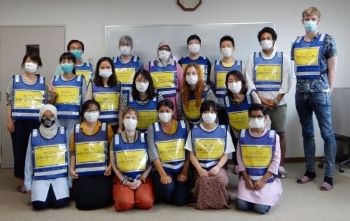
From the perspective of foreign residents from different languages, cultures, and customs, Japan is a foreign country. Even if they don’t have any difficulties in their daily lives, there are not many foreign residents who would take the same actions Japanese people would during an emergency disaster situation.
Sendai Foreign Resident Disaster Prevention Leaders take it upon themselves to learn about disasters and disaster prevention, then share this new knowledge with other foreign residents around them. They will leap into action along with others in their community when a disaster strikes.
Supplying Useful Multilingual Information for Disaster Prevention
SenTIA provides several different multilingual publications/videos/radio programs that foreign residents can use for disaster prevention.
Pamphlet for foreign residents: “Do you know where to go in the event of a disaster?” (in 6 languages)
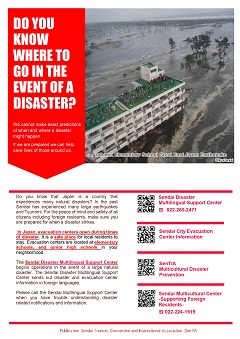
Aimed at foreigners who have recently moved to Sendai City, this pamphlet introduces multilingual support services during times of disaster, as well as designated refuge areas alongside other topics. Please make use of this pamphlet to find facilities and institutions that welcome new foreign residents such as schools and workplaces. Easily access the information and institutions listed below by scanning the QR codes.
Color, double-sided (Front: foreign language, Back: Japanese)
Contents:
- Sendai Disaster Multilingual Support Center
- City of Sendai designated refuge areas
- Sendai Tourism, Convention and International Association – SenTIA (multicultural disaster prevention initiatives)
- Sendai Multicultural Center
Multilingual Boards (13 Languages)
The City of Sendai has created these Multilingual Boards and distributed them to all refuge areas so that they can provide the required information during times of disaster in multiple languages.
These boards were developed using materials created by the Council of Local Authorities for International Relations (CLAIR).
Since Easy Japanese is printed alongside foreign languages, information can be easily provided to both foreign resident evacuees who do not understand Japanese and Japanese children.
These Multilingual Boards can be used in places other than evacuation centers, so please download them from the link below and put them to good use.
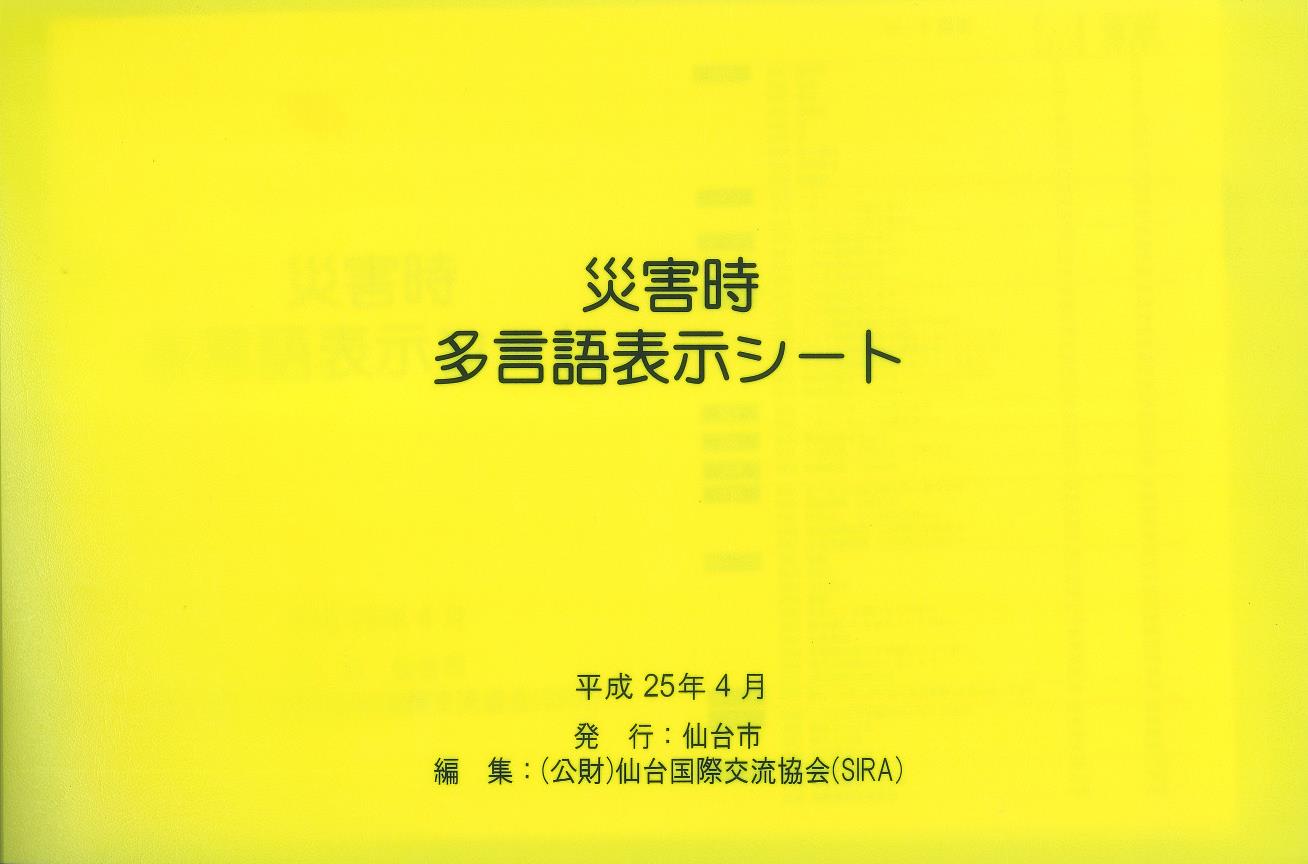
.jpg)
See details for the Multilingual Boards here.
(Link to the Council of Local Authorities for International Relations (CLAIR) website)
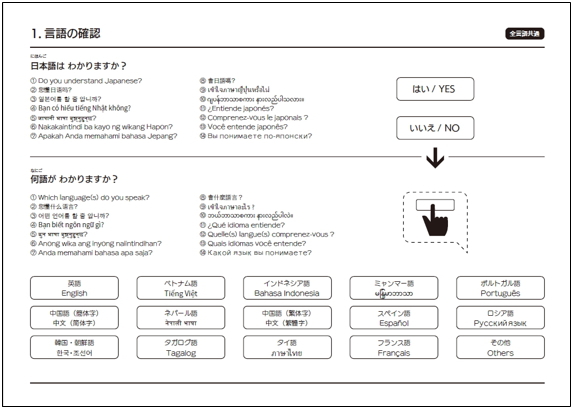
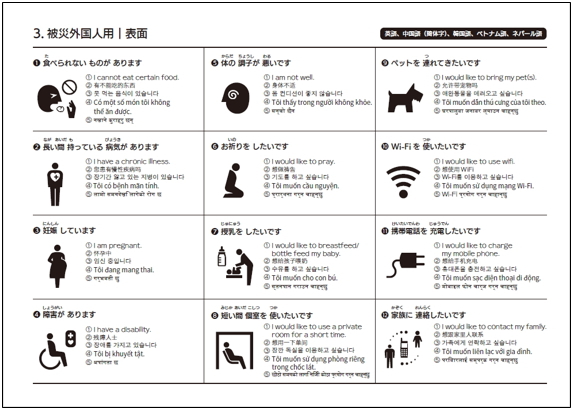
Multilingual Pointer Boards (15 Languages)
The City of Sendai has created and distributed Multilingual Pointer Boards for all refuge areas to use during times of disaster.
These boards were printed and edited to be easily used at evacuation centers in Sendai City, using materials created by the Council of Local Authorities for International Relations (CLAIR).
There are also “food pictograms / FOODPICT” which can be used to confirm dietary restrictions due to religious beliefs or allergies.
These Multilingual Pointers can be used in places other than evacuation centers, so please download them from the link below and put them to good use.
It’s an earthquake! What should I do? (In 12 Languages) - Multilingual Disaster Prevention Video
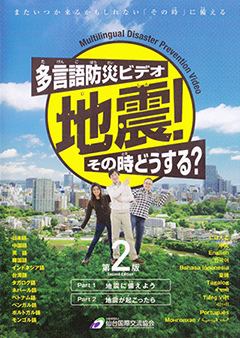
This video is aimed at foreign residents who have never experienced an earthquake before and gives them helpful advice and information. It covers how to prepare for an earthquake and what to do when one occurs, all explained simply. You can watch it on YouTube.
| Japanese (Japanese Subtitles) |
Part 1:Let’s Get Ready for an Earthquake | Part 2:What to do in an Earthquake |
|---|---|---|
| Chinese (Chinese Subtitles) |
Part 1:Let’s Get Ready for an Earthquake 多种语言防灾录像Part 1: 为防震做准备 中文 |
Part 2:What to do in an Earthquake 多种语言防灾录像 Part2: 当地震发生以后 中文 |
| English (English Subtitles) |
Part 1:Let’s Get Ready for an Earthquake Multilingual Disaster Prevention Video Part 1: English |
Part 2:What to do in an Earthquake Multilingual Disaster Prevention Video Part 2: English |
| Korean (Korean Subtitles) |
Part 1:Let’s Get Ready for an Earthquake 다언어 재해 방지 비디오 Part1: 지진에 대비합시다 한국어 |
Part 2:What to do in an Earthquake 다언어 재해 방지 비디오 Part 2: 지진이 일어나면 한국어 |
| Indonesian (Indonesian Subtitles) |
Part 1:Let’s Get Ready for an Earthquake Video persiapan bencana multibahasa Bagian1: Mari persiapkan diri untuk gempa Bahasa Indonesia |
Part 2:What to do in an Earthquake Video persiapan bencana multibahasa Bagian2: Jika gempa terjadi... Bahasa Indonesia |
| Taiwanese (Taiwanese Subtitles) |
Part 1:Let’s Get Ready for an Earthquake 多國語言防災影片 Part1:為地震做準備 臺語 |
Part 2:What to do in an Earthquake 多國語言防災影片 Part2:地震發生的話 臺語 |
| Tagalog (Tagalog Subtitles) |
Part 1:Let’s Get Ready for an Earthquake Multilingual Disaster Prevention Video Part1: Maghanda para sa lindol Tagalog |
Part 2:What to do in an Earthquake Multilingual Disaster Prevention Video Part2: Kapag Nangyari ang lindol Tagalog |
| Nepali (Nepali Subtitles) |
Part 1:Let’s Get Ready for an Earthquake बहुभाषीय विपत्ति निवारण भिडियो भूकम्पको तयारी गरौं नेपाली |
Part 2:What to do in an Earthquake बहुभाषीय विपत्ति निवारण भिडियो भूकम्प गएको खण्डमा नेपाली |
| Vietnamese (Vietnamese Subtitles) |
Part 1:Let’s Get Ready for an Earthquake Video về phòng chống thiên tai dưới nhiều ngôn ngữ Part1: CHUẨN BỊ TRƯỚC ĐỘNG ĐẤT Tiếng Việt |
Part 2:What to do in an Earthquake Video về phòng chống thiên tai dưới nhiều ngôn ngữ Part 2: KHI ĐỘNG ĐẤT XẢY RA ... Tiếng Việt |
| Bangla (Bangla Subtitles) |
Part 1:Let’s Get Ready for an Earthquake বহুভাষী দুর্যোগ প্রতিরোধ ভিডিও ভূমিকম্পের জন্য পূর্বপ্রস্তুতি বাংলা |
Part 2:What to do in an Earthquake হুভাষী দুর্যোগ প্রতিরোধ ভিডিও ভূমিকম্প অনুভূত হলে বাংলা |
| Portuguese (Portuguese Subtitles) |
Part 1:Let’s Get Ready for an Earthquake Vídeo Multilingual de Prevenção contra desastres Parte1: Português |
Part 2:What to do in an Earthquake Vídeo Multilingual de Prevenção contra desastres Parte2: Português |
| Mongolian (Vertical Subtitles, Cyrillic Subtitles Included) |
Part 1:Let’s Get Ready for an Earthquake Олон хэл дээрх гамшгаас сэргийлэх видео1-р хэсэг: Монгол хэл (縦文字、キリル文字 字幕) |
Part 2:What to do in an Earthquake Олон хэл дээрх гамшгаас сэргийлэх видео2-р хэсэг: Монгол хэл (縦文字、キリル文字 字幕) |
Multilingual Disaster Prevention Pamphlets: “Advice for Protecting Yourself in an Earthquake” (Available in 11 Languages)
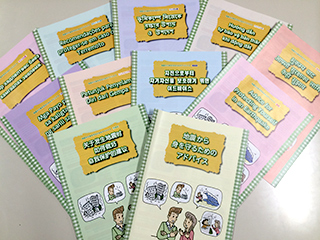
This pamphlet is aimed at foreign residents who lack any prior knowledge of or experience with earthquakes. It has information related to earthquake preparation and what to do in the event of an earthquake. It is presented in an easy-to-understand way and includes illustrations.
Color, 8 pages
Content:
- Let’s Learn About Earthquakes/ Problems Encountered in the Great East Japan Earthquake
- What You Can Do to Prepare for an Earthquake
- When there is an Earthquake
- After Tremors Have Settled Down
- Commonly-Used Japanese Phrases in Times of Disaster
- Japanese Language Version[PDF]
- Chinese Language Version[PDF]
- English Language Version[PDF]
- Korean Language Version[PDF]
- Indonesian Language Version[PDF]
- Tagalog Language Version[PDF]
- Nepali Language Version[PDF]
- Vietnamese Language Version[PDF]
- Bangla Language Version[PDF]
- Portuguese Language Version[PDF]
- Mongolian Language Version[PDF]
Multilingual Disaster Prevention Pamphlets: “Advice for Protecting Yourself from Flood Damage and Landslides” (Available in 6 languages)
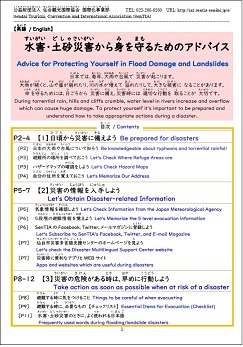
This informational booklet includes information to preparation for flood and landslide disasters, and how to respond in the event of a disaster, using photos and illustrations alongside easy-to-understand explanations.
Color, 12 pages
Contents:
- Be prepared for disasters (Information on torrential rainfall, typhoons, refuge areas, hazard maps etc.)
- Obtain Disaster Related Information (Japan Meteorological Agency, 5 level evacuation information, useful websites and apps during a disasters.)
- Take Action immediately When at Risk of a Disaster (things to be careful of when evacuating, essential items, frequently used Japanese during a disaster)
(Leaflet) Important Points about Disaster Response Drills (Available in 6 languages)
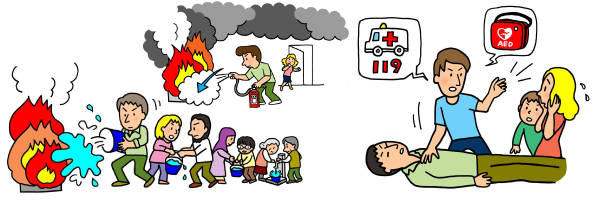
Learn with helpful illustrations about the important points in disaster response drills. This leaflet is used by foreign residents and Multilingual Disaster Support Volunteers, when they participate in disaster response drills.
Date fm’s “Global Talk” - “Sunday Morning Wave” Program Corner!
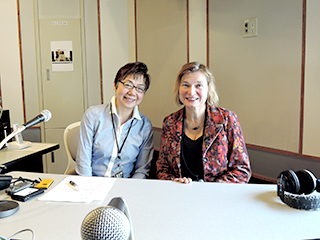
Date fm hosts a disaster prevention radio program called “Sunday Morning Wave,” with a special “Global Talk” section that airs on the second Sunday of the month. We have been participating in cooperation with this section of the program since November 2005. On the program, we welcome a foreign guest and interview them on their experiences of with earthquakes and disaster preparedness in Japan.
In the event of a large-scale disaster, SenTIA works with Date fm to send out disaster information in a variety of languages.
For more information about Date fm’s Global Talk Radio Program, please see the Date fm webpage.
Lessons from the Great East Japan Earthquake
“Lessons from the Great East Japan Earthquake-When a Large-scale Disaster Strikes, Reconsidering How Local International Associations in Prefectures and Designated Cities Work Together and Complement Each Other” (Japanese Only)
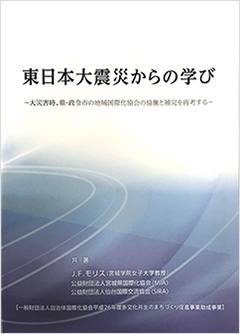
A collaboration between J.F. Morris, Miyagi International Association and Sendai Tourism, Convention and International Association
Published in January 2015
J.F. Morris, a resident of Miyagi Prefecture and employed at Miyagi Gakuin Women’s University, worked together with the Miyagi International Association and Sendai International Relations Association (cur. Sendai Tourism, Convention and International Association) to produce this volume to reflect on the disaster.
For more information about “Lessons from the Great East Japan Earthquake”, please click
here.
(日本語サイトへ)
Workshop Materials: “Multicultural Disaster Prevention Workshop - Thinking about a Multicultural Society through Disaster Prevention”
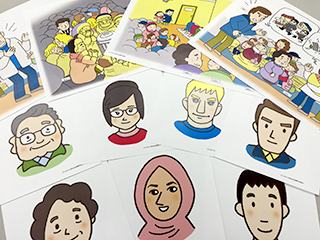
This workshop uses materials based on issues that both Japanese and non-Japanese people may experience at refuge areas in the event of a disaster. It talks about cultural and language misunderstandings, followed by how to deal with and prevent them through conversation on the issues they may face.
We offer these materials for free. Please feel free to visit the website below for more details and to access the application form.
Report on “Multicultural Disaster Prevention” Cooperation Models(Japanese Only)
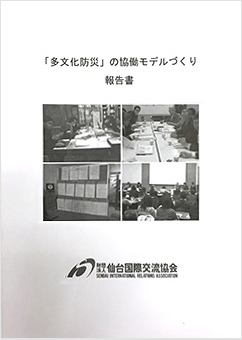
This is the report of a research study on the effectiveness of the disaster prevention activities conducted by the Multilingual Disaster Support Volunteers, Sendai International Relations Association (cur. Sendai Tourism, Convention and International Association) and City of Sendai after the Great East Japan Earthquake; this report also looks into methods of increasing the effectiveness of community disaster prevention from a multicultural perspective. This study began seven months after the disaster, in October, and lasted for six months.
Included within the report is an activity report of the Sendai Multilingual Disaster Support Center followed by survey results from Sendai’s foreign residents as reference materials.
Published March 31, 2012
“Multicultural Disaster Prevention” Report on Cooperation Models(Japanese Only)[PDF]